Single-use waste
Hundreds of millions of paper bag tags are printed every year, used once, then binned. A visible, everyday obstacle to Net Zero commitments.

TagForLife stays on the bag for life and is rewritten over the air for every flight. Check in from anywhere, drop and go, and follow your bag door to door. No printing, no re-tagging.
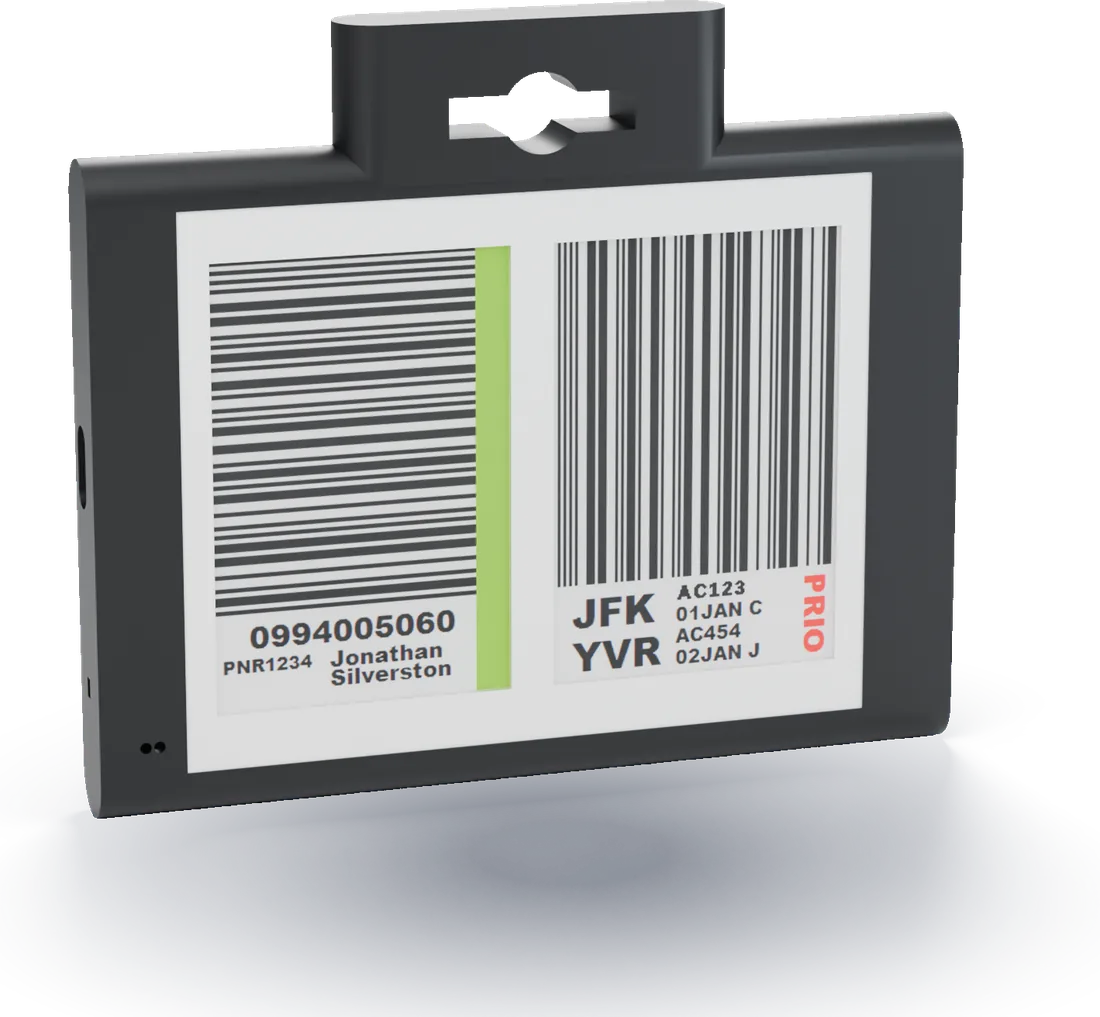
Every day, airlines print a paper tag, stick it to a bag and throw it away a few hours later. Then they do it again on the next flight. It’s one of the last single-use habits in a modern airport, and it quietly costs carbon, space and passenger patience.
Hundreds of millions of paper bag tags are printed every year, used once, then binned. A visible, everyday obstacle to Net Zero commitments.
Because a tag has to be printed, passengers are anchored to desks and kiosks, creating queues at the busiest points and filling valuable floor space.
A barcode gives airlines only a handful of reads between check-in and the aircraft. Passengers get almost none.
One tag stays on the bag for its whole life. Each trip, it simply rewrites itself.
At home, a hotel or a remote site, with the TagForLife app or your airline’s app.
Flight details are written to the e-paper over Bluetooth. RFID and barcode are set for the journey.
Ultra-Wideband detects and identifies the bag as it arrives, for touchless bag drop in seconds.
Airport anchors and find-my tracker networks follow the bag. You see when it’s loaded on board.
Know when it reaches the carousel. Rush bags and re-flights are rewritten over the air.
Two minutes, from checking in at home to collecting the bag in New York.
Captions are built into the film, so it works with the sound off.
One durable device that cuts waste, frees up the terminal and gives everyone better visibility of every bag.
One durable tag replaces a fresh paper tag on every flight, for years. Retiring single-use tags across a network is a simple, visible step towards Net Zero.
When passengers check in at home, a hotel or a remote site, far fewer need a desk or kiosk. Shrink check-in and bag-drop footprints and redeploy the space for security, retail and experience.
Off-airport check-in and touchless bag drop take the pressure off peak hours. UWB identifies the bag as it arrives, so drop-off takes seconds.
Check in from home, drop and go, then head straight to security. The app confirms when the bag is loaded on board and, on arrival, when it will reach the carousel.
A bag already tagged for its flight can be collected from the passenger’s door. One display can show a delivery address for a rush bag, and find-my tracking gives precise geo-location from collection to doorstep.
Low-cost beacons spot a bag that missed its flight. A report is filed automatically (re-flight integration is being developed with SITA) and the tag is rewritten for the next flight. No re-tagging.
Bag locations flow to airlines and airports through IATA BIX messaging, and phone-based tracker networks can detect the tag worldwide.
The T-Code barcode, IATA RP 1740c RFID and standard Bluetooth® LE mean today’s scanners, baggage systems and departure control systems keep working.
In a baggage system, the automated tag reader has to see the barcode, but a tag can land on the belt either way up. A single-sided electronic tag that lands face-down can’t be read, and that bag is sent to manual encoding.
Optical, RFID, Bluetooth® LE and Ultra-Wideband, engineered into a rugged, rechargeable tag that is designed to fly.
Two 2.7-inch displays on each side, written separately: bag tag barcode, flight details, airline branding or a courier address.
A battery-assisted passive RFID tag, readable by airport RFID infrastructure. It only backscatters: there is no intentional transmitter.
Ranging with TagForLife anchors locates a bag to about 30 cm, even on a moving conveyor: the basis for touchless bag drop and pin-point tracking in bag halls.
Links the tag to the app for check-in and display updates, talks to airport anchors and works with find-my tracker networks so the owner can locate the bag.
Every write to the tag (display image, bag weight, buzzer, unpair) is authenticated with a unique per-device key using HMAC-SHA256, with replay protection over an LE Secure Connections link. Firmware updates are signed.
A built-in accelerometer manages the radios: no Bluetooth or UWB transmissions from aircraft door close to arrival. The sealed battery is well below airline limits.
| Physical | |
|---|---|
| Size (in silicone skin) | 117.5 × 87.4 × 14.9 mm; strap lug 56 × 16 mm |
| Weight | Target ≤ 120 g with skin |
| Enclosure | Polycarbonate base and lid, flame-rated (UL 94 V-1 or better) around the battery |
| Display window | Chemically strengthened, anti-reflective glass on both faces |
| Outer skin | 2 mm silicone, no small detachable parts |
| Ingress protection | IP44 (IEC 60529) with skin fitted and USB-C port covered |
| Durability | Designed for 1.0 m drops onto concrete and baggage-conveyor impact; strap lug designed for ≥ 250 N pull |
| Displays & controls | |
| Displays | 4 × 2.7-inch black/white/yellow/red e-paper, 264 × 176 px, two per side; image persists with no power |
| Barcode | Bag tag barcode on both faces in a “T” layout for automated tag readers |
| User controls | Locate buzzer (30 s tone), SOS switch, red and green status LEDs, reset pinhole |
| Sensor | Accelerometer for motion wake-up and flight detection |
| Radio | |
| Bluetooth® Low Energy 5.4 | 2400–2483.5 MHz, ≤ 10 dBm e.i.r.p. App link, airport anchors and find-my tracker networks |
| Ultra-Wideband | 6.0–8.5 GHz; ranging and location to about 30 cm |
| UHF RFID | IATA RP 1740c, battery-assisted passive tag, 860–960 MHz, backscatter only |
| Flight mode | No Bluetooth or UWB transmission from aircraft door close to arrival |
| RF exposure | Total available power below the EN 62479 low-power threshold (20 mW) |
| Power | |
| Battery | Single-cell Li-ion polymer, 3.7 V, 2.68 Wh (≈ 725 mAh), sealed, with protection circuit (over-charge, over-discharge, over-current, short circuit) |
| Charging | USB-C, 5 V; charges only between 0 °C and 45 °C (charger and cable not supplied) |
| Security & privacy | |
| Authentication | Unique per-device keys, no universal default passwords; all writes authenticated with HMAC-SHA256 and replay protection; LE Secure Connections bonding |
| Key storage | Protected key storage on the tag; hardware-backed iOS Keychain / Android Keystore on the phone |
| Firmware | Signed updates only, with anti-rollback, delivered over Bluetooth from the app |
| Privacy | No personal data readable in clear text; unwanted-tracking protections; factory reset clears pairing, keys and personal data |
| Design standards | Designed to EN 18031-1 and EN 18031-2 cybersecurity requirements and UK PSTI rules |
| Environment | |
| Operating temperature | −20 °C to +60 °C |
| Charging temperature | 0 °C to +45 °C |
| Storage | −20 °C to +45 °C at 30–60 % charge |
| Altitude | Designed to withstand 11.6 kPa (UN 38.3 T1) |
| Materials | Mercury-, BFR- and PVC-free; designed to RoHS and REACH |
Specifications describe the production design (model TFL-EBT-01) and may change before release. Compliance information will be published on our compliance page.
Reads and locations from the tag reach the systems airlines and airports already use, through standards-based IATA messaging.

TagForLife comes ready to travel, with everything you need to fix it to your bag and get going. Pair it with the app, check in, and your tag updates itself.

Want one for your next trip? Register your interest and we’ll let you know as soon as TagForLife is available to buy.

TagForLife is designed in the UK by Shabstec, a team with over 25 years’ experience delivering products and services to the aviation industry. We help airports digitise and optimise baggage system performance, with cloud-based solutions that help clients deliver exceptional passenger service.

An electronic bag tag (EBT) is a reusable, battery-powered tag that stays on your suitcase and shows the airline bag tag barcode on an e-paper display. Instead of printing a new paper tag for every flight, the tag is updated over Bluetooth from your phone when you check in.
Pair TagForLife with the TagForLife app or your airline’s app, check in from home, and the bag tag is written to the tag’s e-paper displays. At the airport you drop your bag and go. UHF RFID, Bluetooth LE and Ultra-Wideband let airports read, locate and track the bag along its journey.
A bag can land on the conveyor either way up. TagForLife shows the barcode on both sides, behind anti-reflective glass, so automated tag readers can read it first time and fewer bags are sent to manual encoding.
Yes. It uses a sealed 2.68 Wh lithium-ion polymer battery, well below the 100 Wh airline limit, and its Bluetooth and Ultra-Wideband radios stop transmitting from aircraft door close until arrival.
Yes. Its T-Code barcode works with today’s automated tag readers, its UHF RFID follows IATA RP 1740c, and bag location data is shared through IATA BIX messaging, so scanners, baggage handling systems and departure control systems keep working.
Electronic bag tags remove single-use paper tags, cut check-in queues, free up space in check-in halls, improve read rates and give airlines and passengers better visibility of every bag, from home pickup to the carousel.
Online sales are coming soon. Register your interest using the enquiry form and we’ll let you know as soon as TagForLife is available to buy.
Talk to us about a proof of concept, from a single bag-hall UWB trial to a network-wide rollout. Or register your interest in buying a tag. We’ll reply within two working days.